Monday, July 22, 2013

Bourg St Maurice and Chambery

The taxi ride down from Chapieux to Bourg was somewhat hair-raising. A typical winding alpine road where cars have to stop  to pass each other, with mountains on one side and precipice on the other, and our driver occasionally looking at the road while trying to connect to Internet on his phone. All ended well, he did find his doctor´s address and arranged for her to see Annika  more or less straight away, and we could soon pick up a bagful of medicines in a pharmacy.

Grande Rue, Bourg St. Maurice
Rochefort ruin, Bourg St Maurice
We did not get much information in the tourist office, but found a really interesting brochure that gave us ideas for the coming days - on doctor´s orders we were not to go to higher altitudes.Bourg, known since Roman times, has a nice centre with some 17th century town houses - our hotel The Savoyard was right on the Grande Rue -  outside the centre, it was mostly  large and expensive-looking family houses surrounded by gardens. All that is left of the Rochefort castle is a ruined tower - the castle was washed away by what now appears to be a harmless brook some 100 m distant.


Beaufort cheese being made
One of the local specialities is Beaufort cheese, a soft variant of Gruyere with a characteristic concave edge (said to facilitate roping the cheese wheels onto donkeys), and we went to see the plant. Fun to see, with open coppered vats, but fully automated filling of the large molds.


Musée de la Pomme, La Chal


There was supposed to be a church with worthwhile baroque furnishings in a village above Bourg, but when we got there it was closed, so the next goal was a Museum of the Apple in yet another village, La Chal. Charming village with largely authentic buildings, in stone and with open space under the roof. The museum turned out to be two tiny houses containing the ancient village fire engine, an apple press and some pictures, but quite charming, with a fruit orchard conserving the old varieties.
Our next target however, in the Vulmix village on the opposite site of the valley was an all out success. A small chapel with never restaured fresco paintings from the fifteenth century covering all of walls and ceiling, a comics style picturebook with Bayeux tapestry charm. One had to ask a Mme Besko to open the chapel and she gave a perfect explanation of the picture story, the quest of Aosta bishop Gratus for the head of St John Baptist (he found it in the well of Herod´s palace in Palestine, brought it to Rome and the grateful pope granted him St John´s jaw to take home; it is now the major relic in the Cathedral of Aosta).
Chapelle St Grat, Vulmix


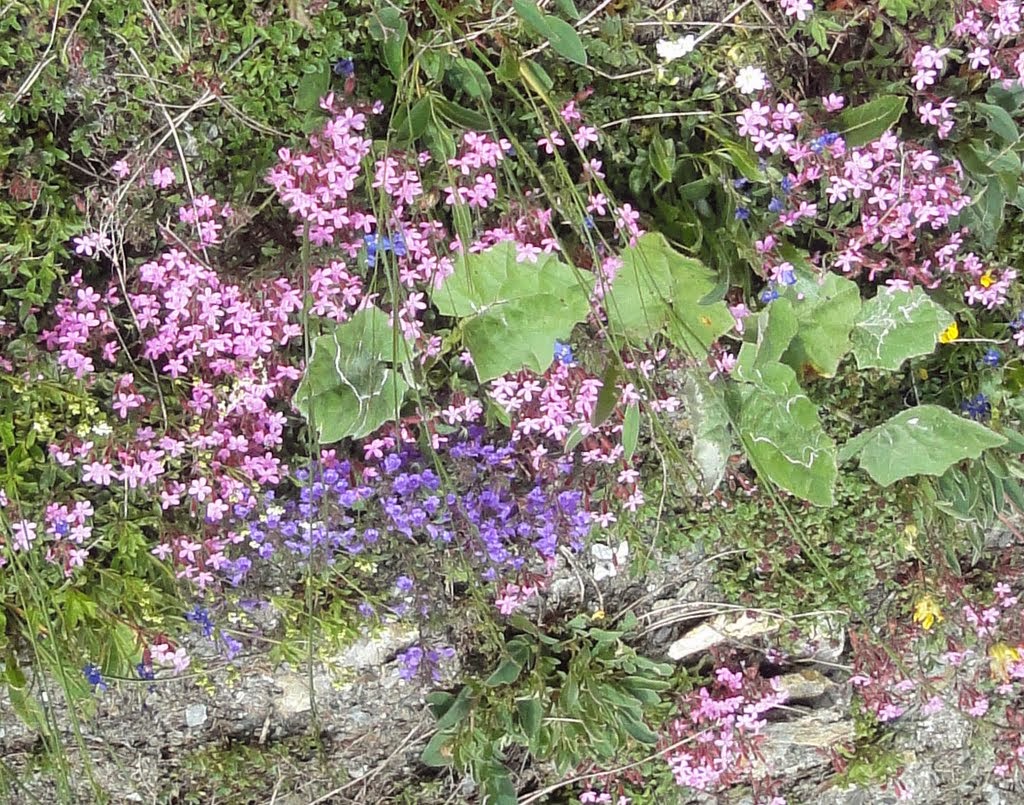
The walks gave great views of the valley. We also ran across what at first appeared to be a plant having flowers of two different kinds and colours. On closer look one can see that the actual flower is yellow, but the top leaves have turned a vivid violet. On the net, there are a few similar pictures, but none gives the plant a name.
Bourg St Maurice from the Vulmix road

Salad SavoyardeTartiflette
In the evening we tasted i.a. Salade Savoyarde - with Beaufort, lardons and croutons, excellent but would have served as a main dish - and  Tartiflette, a potato gratin with Reblochon, no less nourishing.

Elephant Fountain, Chambery
There was no morning connection from Bourg to Geneva, so we decided to spend the night in Chambery. It turned out to be well worth visiting, a former capital of Savoy. The town´s best known sight is the elephant fountain, with four realistic lifesize elephant halves (it is said to be called Les quatre sans cul)
We had dinner in the town hall square which was hosting a folklore festival,  had a taste of another tasty savoyard speciality, a sausage called diot, served with polenta and red wine sauce, and walked around to see the ducal chateau and a few imposing buildings grouped around the Palais de Justice,  the art museum (former granary!) and Hôtel des Douanes.

Hôtel de Ville, Chambery
Diots au vin rouge
Chateau, Chambery
Musée des Beaux-Arts
Palais de Justice
Hôtel Clermont Mont Saint Jean
(Hôtel des Douanes)
Nice views continued on our train trip to Geneva.


Sunday, July 21, 2013

Tour de Mt Blanc

In between two babysitting periods in Brussels, we intended to squeeze in a week´s hiking on the Tour du Mont Blanc.

Courmayeur

We chose to do the TMB in the nontraditional clockwise sense, starting from Courmayeur - the connection via Alpybus Geneve Airport -Chamonix and public bus Chamonix-Courmayeur was excellent, we got to Courmayeur at lunchtime and only planned a short walk to the nearest hut, Refugio le Randonneur.
Le Randonneur
The short walk through the woods turned out to have 800m elevation, and with the heat and the flies and the mosquitoes was not quite the dream start. We were alone in the refuge´s dortoir, a nicely furnished and well kept old house, and the family running the refuge and restaurant served excellent food, including homemade cake.

The first proper hike was along a ridge with wonderful views of Mte Bianco di Courmayeur massive to Arp Vielle, than down to the mouth of Miage Glacier (no ice as far as one could see) and along the Vallone de la Lex Blanche to Refugio Elisabetta. Easy pleasant walking, apart from a few landslides blocking the valley road, and a few snowfields covering the path in a few places higher up; we had good use of our Huang Shan walking sticks there. We got to see marmots quite close and chamois at a distance, and a profusion of flowers.

Refugio Elisabetta Soldini
The Elisabetta is quite strategically placed but can not be recommended. It was overcrowded-we had to wait until quite late for our turn at dinner (and they served half-cooked risotto). Particular warning for the dortoir - 24 people on 3 shelves above each other, only one working toilet, no hot water - and most of the ceiling and some of the walls covered by black mould!

Sunshine even on our third day, again an easy uphill walk, but we had forgotten how to pack for hiking, my backpack was overloaded and my shoulders started to ache. The small nature information hut of Casermetta was a welcome break, the terrace had information on geology, flora and fauna, and panaramatic pictures identifying all the peaks in view.
Casermetta terrace
Setting out of Elisabetta

Col de Seigne with Mt Blanc
Towards Les Chapieux
 The Colle dela Seigne pass - our highest altitude, 2510m - had wonderful views, our first view of Mt Blanc proper, all the imposing peaks along Lex Blanche and at the other side the mountains to the west.  
From the pass it was essentially downhill, after a while the valley opened up to show alpine farms with cattle, and the Mottetes and Ville de le Glaciers refuges a few miles away.  A surprising feature along the path was the very narrow and deep ditches or furrows created by running water.   
A pleasant walk along the valley floor took us to Auberge de la Nova in Les Chapieux. Again a nice place, and we had a delicious local dish there - cow´s cheeks.


Unfortunately, Annika´s ear inflammation, which was troubling from the start of the trip got so much worse by the morning that we had to break off the hike and take a taxi to a doctor in Bourg St Maurice.

Monday, December 10, 2012

Huangshan - Yellow Mountains


Sea of mists


Ever since I have seen those Chinese ink paintings of impossibly steep mountains and gnarled pines I have wanted to go to Southern China to see the landscapes that inspired them. It turned out that art meticulously copied nature, Chinese painters actually travelled to Huangshan and draw what they saw. The place would be practically inaccessible to humans (I do not consider mountain climbers to be completely human), but over ages, staircases were hewn in raw rock and smooth walkways built, so that 4 people can walk in breadth in most places - totally unlike any mountain hike we have ever seen. It is a strain on your knees, but you could walk in flipflops.

We decided to spend a night on the mountain, for several reasons. One was that it usually rains there, so two days gave us more of a chance to see anything, the other that seeing the sunrise or sunset is a must according all the guidebooks. We were lucky to see the mountain tops rising out of the mists, all of a sudden making clear why a parts of the mountain was called Northern Sea.

Huangshan is considered by Chinese to be one of their top attractions, right there with the Great Wall, but is all but unknown in the West. Even on a weekday, the main paths were teeming with Chinese tourist groups and tourguides with megaphones, but we met only a handful of westerners. Many of the Chinese must have been rural people, because we were repeatedly asked to pose in photographs with them.

Spot the odd man out
Tourist view


Given the popularity it was not strange that the few hotels on the mountain charged five times more than the hotels below. They have to have everything delivered on carriers back - no roads, only the walking paths. The lack of western clients probably also explained that the proudly announced western breakfast at 16 EUR offered the choice of egg or no egg and two kinds of bread, with no butter.
Much easier than
taking pictures outside

Sunday, November 25, 2012

The Terracotta Army


 The Terra Cotta Warriors and Horses
The next day our student guides took us the terracotta army east of  Xian. Although we actually saw a few of the warrior statues when they were touring the world in the 80 ies the seemingly endless rows of life sized generals, infantrymen, archers, cavalry,strongmen and musicians depicting the army of the first Chinese emperor Qin Shi Huang who also built the Great Wall, were really a once of a lifetime sight.
This amazing world heritage site was hidden to the world until 1974. There had been previous reports about pieces of terracotta found close to the tomb of the first Chinese emperor Qin  but no excavations had been performed. It was incidentally discovered by a farmer drilling a well. Several drilling attempts had been made but all had been terminated just above the pits containing the army and the farmer who did not give up literally struck gold. He is still alive, and signs the official guidebook in a huge museum store, which also sells overprized warrior replicas in all imaginable materials and sizes 
We were assigned a competent guide, a Chinese woman speaking reasonably good English but we were amazed that at first she seemed to be prouder of the grandiose museum building and the celebrities whO had signed its guestbook than of the terracotta army itself. When we came into the first exhibition room her voice was drowned out  by an unbelievable  cacaphony as the place was swarmed with enthusiastic, loud  Chinese tourists.


The statues were placed in more than 200 m long pits divided into corridors with wooden ceilings. When the pits were first excavated the statues were found in pieces; it is said that the emperor´s enemies found the army after his death and smashed it on purpose. So far, only one soldier was found intact.  Remnants of burnt rafters were found and some of the statues had also been damaged by fire. Probably the wooden constructions were burnt by looters, supported by the fact that most weapons are missing. The few which have been found show impressive bronze metallurgy capabilities,  i.a. chromium surface plating for hardness and corrosion resistance. Surprisingly, iron was only found in tools, not in weapons, perhaps it was not considered good enough for an emperor. A not restored part with cruched statues can be seen in pit number 1 (there are 4 pits, the 4th one however unfinished and empty) Pit number one is actually said to contain more than 6000 statues.We were told that 40 archeologists work on the site, and 2000 assemble the pieces.The figures were made in separate parts that were assembled, which explains that some of the soldiers lack their head. As for those who dont you can see that the facial features differ. It is believed that eight different face moulds were used and then additional clay was used to sculpture the individual faces and facial expressions. Also the head gear and intricate hairstyles differ and indicate rank and arms of service, officers usually wearing hats, whereas warriors  have their hair tied into a knot. A few statues were on display in showcases and remnants of colour could still be traced on some.